Mana
Tame Iti with Toi Rakau Iti and Eugene Bingham
I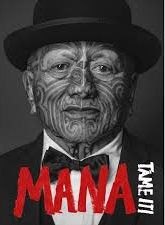 te timatanga (the beginning)
The mist met the mountain and they made love. Their love made us
and we all lived together in Te Urewera. We had everything we needed.
Food, water, shelter. Each other. We had mana. Those were the days.
Born in Ruatoki, Tohoe 1952, Tame Iti tells his life story with assistance from Toi Kai Rakau Iti, his younger son, and journalist Eugene Bingham. While the greater use is made of English, the same information is repeated in te Reo Maori. Both the English and Maori texts flow together.
Apart from the text, the pictures in the book include photographs, paintings by Tame Iti - totalling around sixty visuals - making a huge contribution to the story. It is not just the biography of Tame Iti but the bicultural history of Aotearoa from the 1950s to today.
The book is organised into 22 chapters, following the life of Tame Iti from the fifties to the Hikoi mu te Tiriti to Parliament grounds November 2024. There are some known events in this story – including the Land March led by Dame Whina Cooper in 1975, and the theft of a Colin McCahon painting from the Visitor Centre at Lake Waikaremoana in 1997. The national print media gave full coverage of both events. While reading Tame Iti’s treatment of both events sheds a distinctive voice, this article will focus on three events and themes ignored or only lightly treated in Pakeha media: Journey to China 1973, Jet Boat races on the Whakatane River late 80s/early 90s, and Tame Iti as Actor/Artist.
The New Zealand Communist Party organised a visit to China for Maori leaders in 1973. Having taken part in Nga Tamatoa (young warriors) protests on Parliament grounds in 1972, Tame had gained national prominence in the media. The invitation to join came to the local Ruatoki post office, addressed to the ‘Maori Ambassador’, the title Tame Iti chose when setting up tents outside Parliament. While the local Ruatoki postal service was puzzled, Tame Iti’s persona had followed him home! The door was open for him to join the five delegates, including the poet Hone Tuwhare. It was his first trip overseas and the period of the Cold War, a tense time to be in China. But challenging as well: ‘I saw millions of people mobilised, working together in ways that were hard to fathom. They were doing massive work – like moving entire hills! – with nothing but their hands. No machines, just people. He mahi nui tera. It shifted my perspective, globally and politically. I started to see the importance of collective effort, of everyone working together, from bottom up. It wasn’t about control from the top, but empowering the people at every level.’
Despite reservations of others in the party trip, a visit across the border to the North Vietnam liberation movement was organised. ‘These were Hmong people, an ethnic minority group from the north. I’ll never forget the moment I saw them. They looked like us. Everything I’d heard about them - how people called them ‘Commos’ or tried to paint them as the enemy – just fell away. They felt familiar. Their kaupapa , their struggle, it was what we were fighting for at home. It was real.’
‘I asked them if I could join their fight, If I could come and push back against imperialism. Their response has stayed with me ever since. They said, “Thank you, Comrade Iti. You should go home to your struggle. Your battle is at home. Don’t worry about us. We’ll take care of this.” Closing thoughts from Tame: ‘That haeranga, that journey, was a turning point. It connected me to the concept of whakawhanaungatanga, of making connections. It showed me how collective action could create change, and how people could come together to mobilise against oppressive forces.’
The story moves from China to Ruatoki, and the annual jet boat competition on the hapu’s sacred river, Ohinemataroa (Whakatane), in the late 1980s/early 1990s. This is how Tame Iti describes the awa: ‘It rises deep in Te Urewera, winding her way past our village, all the way to the moana at Whakatane. She is imbued with mauri (Life force), nurturing and nourishing all within and beside her.’ In the past Tame had watched the annual jet boat races, but with increasing boats competing and larger crowds attending, bringing crates of food and alcoholic refreshments, he resented their intrusion, and told the organiser they could no longer have their jet boat competition in their village home territory. When it was clear the organisers were ignoring this instruction, Tame and a friend attempted to chop down a large willow tree at a narrow gully in the river. They lacked the experience or skills and the willow fell to one side lying on the bank.’
Tame Iti took drastic action, wading into the water up to his waist. Here’s the section where he describes what happens: ‘Then an ominous sound hit my ears. The first jet boat. You can hear them before you see them – the roar of the engine, a distant storm rolling closer…The boat came around the bend, fast and loud, and I saw the driver spot me. For a moment, I thought Is he going to stop? Is he going to try to go around me somehow? Or is he going to come straight through? Is he going to hit me? As he got closer he had only two options: hit me or hit the trees on the bank. You never know with people. When they’re in the heat of the moment, adrenaline pumping, they can do anything. But I was ready for whatever came. I stood there, calm, firm and unmoving. I went into another state of mind like my whanaunga Te Rauparaha, Ka mate, ka mate, ka ora, ka ora, I die, I die, I live, I live!’
The boat did swerve. Tame survived to continue the struggle against the jet boat organisers. Several meetings took place, including on the village marae. Now all the villagers supported Tame Iti’s campaign, finally bringing closure to the jet boat event.
Tame Iti’s reflection at the close of this part of the story: ‘That’s the thing about activism, eh? You can have all the korero, all the whakaro (opinions) in the world but sometimes you just have to act. Sometimes you have to put your body on the line. When I stood in that river that day, it wasn’t just about stopping the boats. It was about mana, ihi, wehi. It was about confronting the colonial system that’s always told us we don’t matter, that their power is more important than relationship to the whenua and awa – whenua and awa that sustained our tipuna for generations.’
The combination of three words ‘mana, ihi, wehi’ occurs frequently in Tame Iti’s story. Tame’s painting, titled ‘Te Ihi, te Wehi, te Mana’, was included in this story. Its caption added these words: ‘The energy and frequency of riri (struggle, battle)’. The three words don’t easily translate into English but are easily interpreted in contexts such as Kapa haka events.
The third and final topic or theme is ‘Tame Iti as artist’. It covers both his own paintings and largescale theatrical productions with Tame working with his two sons.
An appropriate opening to this topic is the words spoken at the foreshore of Waitangi Day grounds 2024. One thousand people carrying white flags had responded to the invitation to join Tame for a display of ‘Kotahitanga (Unity), of peace, of mana. A blank canvas for a fresh start’. Here’s how Tame opens the door: ‘I had to make a call to Ben Dalton, the Chief Executive of the Waitangi Treaty Grounds, to ask if we could do it. I described what I had in mind and he was a bit nervous. ‘Is this a protest?’ he asked. ‘No,’ I told him. ‘It’s art.’ Ahhh,’ he said. ‘Okay’.
While Tame Iti has studied and viewed a wide diversity of art, he developed his unique imagery of individual and collective persons symbolic of ‘human essence/spirit’. Online entries on Google, edited, define this further: ‘Human essence refers to our physical and spiritual makeup, whakapapa (genealogy/identity) and innate uniqueness. It includes those who are intersex or gender diverse and carry inherent worth and identity beyond narrow definitions, emphasizing Maori ways of knowing.’ The painting ‘Te Ihi, te Wehi, te Mana’, mentioned in the Jet Boat story, is reproduced on the front end papers of Mana Tame Iti. Using the European term ‘abstract expressionism’ might be a starter, but the ways in which he weaves his artistic skills showing iwi in act and thought is unique.
Encouraged and supported by others, Tame has set up gallery displays of Maori works including his own, and toured exhibitions on marae and community sites throughout Aotearoa. The closing words of the chapter on ‘The Artist’: ‘Nowadays, I say I’ve been an artist my whole life. I just didn’t realise it when the teacher asked us at kura – I didn’t realise it for decades. I discovered that you don’t have to go to an institution to be an artist. Go back to nga korero whakapapa and you’ll see we’re visual people. We express ourselves in waiata, in kapa haka, in puoro (music), in whakairo (carving), in te moko (body art), in raranga (weaving), te mea, te mea, te mea (that’s the fuller story). We are artists. Kei roto I te tangata tera whakaro – being an artist comes from within you. It’s in your ira tangata and your ira atua (physical and spiritual lives).’ A separate chapter tells the story of how Tame creates his own moko, initially facial but over time etched into the full body.
A striking photograph of Tame and his sons Wairere and Toi opens the chapter titled Tenei to Tira Hou (This is a new team). The T-shirts of the sons carry the words ‘I will speak Maori’, an inversion of the original words ‘I will not speak Maori’ which Tame was forced to write out, over and over, as punishment for speaking te reo during school time. Tame used these words to provoke/invite collective discussion and debate on bicultural race relationships in Aotearoa. Public learning events took place in the Wellington waterfront 2023. A black and white Poster was widely distributed throughout the motu, copied in the style of posters for workers’ political meetings in the past. At the top of the Poster it read: ‘Tame Iti presents’. Under it in white print and very large typeface: ‘I will not speak Maori’. In smaller typeface three lines at the bottom: ‘1972 to 2022/50 Years Anniversary/Te Reo Maori petition and Nga Tamatoa’. It’s an illustration of why Tame thought history should be a compulsory subject in schools. Further to the poster, Wairere used his lighting skills to flash Tame on the side of Te Papa writing out his lines – for those present to feel it and, to quote Tame, extending it ‘into the official memory of Aotearoa’. An extension of this street theatre invited individuals and roopu to take out the word ‘not’ in ‘I will not speak Maori’.
I need to share one last theatrical magic produced by Tame and his sons, involving the New Zealand Symphony Orchestra. It came out of Tame’s contact with Peter Biggs, CEO of the NZSO. He told Tame that the orchestra would like to bring their music to Whakatane. It was a bold move. Usually Maori experts in the ancient instruments took their magic into western classical venues. ‘This time, the orchestra would bring their magic to our world’. There was a six month period of preparation before the performance on December 9, 2023, the four-year anniversary of the Whakari eruption. The orchestra had prepared a seventy minute orchestral score and soundscape, a collective work by Laughton Kora, Toi Kau Rakau, Mahuia Bridgman Cooper, and incorporating Te Kooti’s moteatea (Chanted songpoetry) of resistance. Tame was given a demo of the score which opened up a whole other universe of emotion and narrative. ‘They became vast, expansive worlds; surging oceans of aroha and tidal currents of loss; stormy swells of sorrow clearing to gentle cadences of hope; thundering percussive rhythms of persistence and sweeping, howling gales of lament.’ Three thousand people turned up to witness the performance, Maori and Pakeha. It was described as ‘transformative and life-changing’ for both performers and the audience. For further details you need to borrow Tame’s book from the library, or better still, buy your own copy.
Three chapters cover the police raids on Tuhoe iwi, October 2007 and their aftermath. Much of the media coverage would have reflected Pakeha viewpoints. Here in Tame Iti’s story we are given the Maori perspective – the Tuhoe story.
John Thornley